
CNC Routers for Chemical Wood
Understanding the unique properties of chemical wood is essential for CNC routing. This section explains how to select an appropriate density grade for the application and summarizes dust-management practices for controlling hazardous dust and maintaining a safe, efficient workspace.
What Is Chemical Wood?
Definition and Material Properties
Chemical Wood (polyurethane tooling board, also called modeling board) is a synthetic modeling material made primarily from polyurethane resin.
The primary characteristic of this material is the absence of natural grain. Its uniform structure provides isotropic cutting behavior. Whereas natural wood varies in cutting resistance and surface finish by grain direction, chemical wood exhibits no directionality, enabling predictable, consistent machining—even for complex 3D geometries.
As a polyurethane-based synthetic resin, it is classified as a plastic, yet it offers a machining feel similar to natural wood along with excellent machinability. Despite its low weight, it provides adequate strength and bonds well with adhesives and accepts paint finishes, so finishing operations are straightforward.
Common Applications and Industries
Chemical wood is widely used in prototyping and mold making. The most common application is manufacturing master models for fiber-reinforced plastic (FRP) molds. Because it can accurately reproduce molds with complex curved surfaces, it is highly valued in prototyping for automotive and aerospace parts.
In the automotive industry, it is used to create design mockups and functional prototypes. By producing product-equivalent geometry with short lead times, it supports design verification and fit checks.
It is also used to produce custom jigs and fixtures for manufacturing environments. Required shapes can be generated quickly, and the material’s low weight simplifies handling on production lines. Additional uses include architectural models, exhibition displays, and props for film and television.
Why Choose CNC Routers for Chemical Wood Machining
Key Advantages Over Manual Processing
CNC routing of chemical wood offers clear advantages over manual processing. The primary benefit is high dimensional accuracy and repeatability. Once a program is created, the same geometry can be reproduced consistently across multiple prototypes or mold components.
The uniform structure of chemical wood is well suited to CNC machining. Unlike natural wood, where hardness varies with grain direction, tool wear is more predictable and cutting parameters are straightforward to optimize. This enables high-precision machining of complex 3D surfaces and fine details.
Complex shapes that are difficult to achieve manually can be produced efficiently with a CNC router. Advanced shape requirements such as fine engraving and smooth freeform curves are supported. Machining time can be substantially reduced, which can significantly shorten prototyping lead times.
Material Benefits for CNC Machining
Chemical wood is lightweight, facilitating setup on a CNC router. Even with density selected by application, common medium-density grades (30–40 lb/ft³) are generally lighter than natural wood or metals of comparable size, with reduced burden on the machine.
Excellent machinability is another advantage. Because cutting resistance is relatively low, tool load is reduced and tool life can be extended. In addition, the hazardous dust generated during cutting tends to be flake-like and is easier to capture than typical wood dust.
The predictability of machining results supports production planning. Chemical wood exhibits less dimensional change due to temperature and humidity than natural wood, with minimal warping or distortion after machining. This enables stable production of high-precision molds and prototypes.
Essential Cutting Parameters for Chemical Wood
Recommended Spindle Speed (rpm)
For machining chemical wood, spindle speed is a critical parameter that influences finish quality. A generally recommended range is 6,000–18,000 rpm. Within this range, the optimal speed is selected based on material density and the machining stage.
For low-density chemical wood (10–20 lb/ft³), begin at relatively lower speeds (6,000–10,000 rpm). Excessive speed can cause the material to soften or smear and may produce edge fuzzing.
For medium- to high-density materials (30–75 lb/ft³), higher speeds (12,000–18,000 rpm) are effective. Elevated spindle speed can produce smoother surface finishes and can help reduce tool chatter. Higher rpm settings are particularly suitable for finishing operations.
Feed Rate and Depth of Cut
Feed rate should be adjusted according to material density, tool diameter, and machining stage. For roughing on medium-density material, a feed rate of 100–200 ipm (2,500–5,000 mm/min) is typical, supporting efficient material removal while limiting tool load.
For finishing, reducing the feed rate to approximately 50–100 ipm (1,250–2,500 mm/min) can yield a smoother surface. Lower feed allows the cutting edge to track the surface more closely, reducing fine irregularities.
Depth of cut (DOC) should be set in line with tool diameter, material density, and machine rigidity. As a roughing strategy, leaving approximately 0.5–1.0 mm (0.020–0.039 in.) of stock for finishing is recommended. Excessive DOC in a single pass increases the risk of tool breakage and may cause thermal deformation of the workpiece. Multiple shallow passes support stable machining.
Multi-Pass Machining Strategy
A gradual, multi-stage approach provides the most consistent results. First, perform roughing to establish the overall shape, leaving 0.5–1.0 mm (0.020–0.039 in.) of stock from the final surface. Emphasize efficient removal using relatively fast feed rates and deeper DOCs appropriate to the setup.
Next, conduct a semi-finish pass to reduce the remaining stock to about 0.1–0.3 mm (0.004–0.012 in.) in preparation for finishing. Incorporating a semi-finish pass reduces tool load during the final stage and supports higher surface quality.
For the final finishing pass, use the finest parameter settings. A combination of high spindle speed, low feed rate, and shallow DOCs can achieve a very smooth surface approaching a near-polished appearance. This staged approach can extend tool life and improve overall machining quality.
Tool Selection for Chemical Wood
Why Carbide Tools Are Preferred
For machining chemical wood, carbide tools are recommended. Compared with high-speed steel (HSS), carbide offers higher hardness and wear resistance and maintains edge sharpness during extended continuous machining.
Although chemical wood is relatively soft, continuous CNC operation imposes a consistent load on the cutting edge. Carbide tools retain sharpness for longer periods, helping maintain consistent machining quality and reducing the frequency of tool changes. This can improve productivity and reduce overall tooling cost.
HSS tools are usable, but edge wear occurs more quickly, and the loss of sharpness is especially apparent with high-density chemical wood or long machining runs. While initial cost is higher for carbide, its long-term cost performance is generally better.
Flute Count and Tool Geometry
End mill flute count has a significant impact on machining quality and efficiency. In chemical-wood machining, 2-flute and 4-flute end mills are commonly used, each with suitable applications.
2-flute end mills provide larger chip evacuation space, making them suitable for roughing and deep slotting. Lower cutting resistance and smoother chip evacuation reduce the risk of clogging and allow higher feed rates for efficient removal.
4-flute end mills can produce finer surface finishes, making them well suited to finishing operations. Because the number of cuts per revolution increases, surfaces are finer and more uniform. Attention to chip evacuation is required, and appropriate feed settings are important.
Tool shape selection is also important. Ball end mills are suitable for 3D curved surfaces and complex geometries, producing smooth contours. Flat end mills are suitable for planar surfaces and vertical walls, producing sharp edges. Selecting geometry in line with the intended features is central to quality control.
Tool Life and Maintenance Tips
Proper tool management is essential for stable machining quality and productivity. Although carbide is hard, it is vulnerable to impact. Store tools in dedicated holders or cases and avoid contact with other tools to prevent chipping or edge damage.
Timing of tool changes is also important. Indicators such as increased surface roughness, greater burr formation, or changes in cutting sound can suggest tool wear. Regular visual inspection and checking edge condition help prevent quality issues.
After use, remove chips with compressed air and keep tools clean. If fine hazardous dust generated during chemical-wood machining remains on the tool, it can affect machining quality on the next run. With proper maintenance, tool life can be maximized.
Common Machining Challenges and Solutions
Preventing Edge Chipping
Edge chipping is a common issue in chemical-wood machining. It occurs most frequently at the trailing edge (tool exit) and at acute corners, degrading the surface finish.
Proper tool selection is the most effective mitigation. Using sharp, fresh carbide tools enables clean cutting and helps reduce chipping. Worn tools tend to tear or plow the material, increasing the possibility of edge damage.
Optimizing cutting parameters is also important. If feed rate is excessive, the tool plows the material, making edges more prone to chipping. In finishing operations, reducing feed rate while increasing spindle speed can produce smoother cuts with fewer defects.
A staged, multi-pass approach further improves edge quality. After bulk removal in roughing, approach the final geometry with multiple light finishing passes to minimize localized loading at edges and corners.
Achieving Superior Surface Finish
High-quality surface finishes require coordinated settings. For finishing passes, a high-speed, low-feed approach is typical. At 15,000–18,000 rpm, maintaining approximately 2–3 ipm (50–75 mm/min) can yield smooth surfaces.
Depth of cut strongly influences finish quality. In finishing, shallow passes of about 0.1–0.2 mm (0.004–0.008 in.) help minimize tool vibration and produce uniform surfaces. Excessive depth can cause tool deflection and leave waviness.
Tool selection also matters. A 4-flute end mill increases cutting engagements per revolution, supporting finer finishes, while a ball end mill is effective for freeform surfaces and can produce smooth contours. Increasing tool diameter raises stiffness and reduces vibration, which can further improve surface quality.
Toolpath strategy contributes as well. Selecting between climb (down) cutting and conventional (up) cutting based on fixturing and stability can optimize finish; climb cutting generally produces smoother results when workholding is robust.
Managing Fine Dust During Machining
Machining chemical wood generates substantial hazardous dust. Although chips tend to be relatively flake-like compared with natural wood dust, an effective dust-collection system remains essential.
Effective collection improves both the work environment and machining results. Accumulated dust can obscure the cutting zone, and redeposited particles on the cut surface can degrade finish quality.
Collector airflow should be adjusted to machining speed and material density. Low-density chemical wood tends to produce lighter dust and may require stronger suction. Position the collection inlet near the cutter so debris is captured at the source.
Regular maintenance of the dust-collection system is important. Clogged filters reduce suction and impair capture. Cleaning or replacing filters at appropriate intervals helps maintain consistent performance and supports a safe, efficient workspace.
Conclusion: Achieving High-Quality Results with Chemical-Wood Machining
Chemical wood is well suited to precision machining with CNC routers due to its uniform structure and excellent machinability. With predictability and dimensional stability not found in natural wood, it supports efficient production of complex shapes and high-precision prototypes.
High-quality results are achievable—even for less experienced operators—with appropriate knowledge and parameter selection. By understanding material characteristics, starting from recommended conditions, and then tuning for specific equipment and applications, efficient, high-quality CNC machining can be achieved. Ongoing learning and test machining help realize the full capability of chemical wood.
This media is sponsored by The SHODA Company
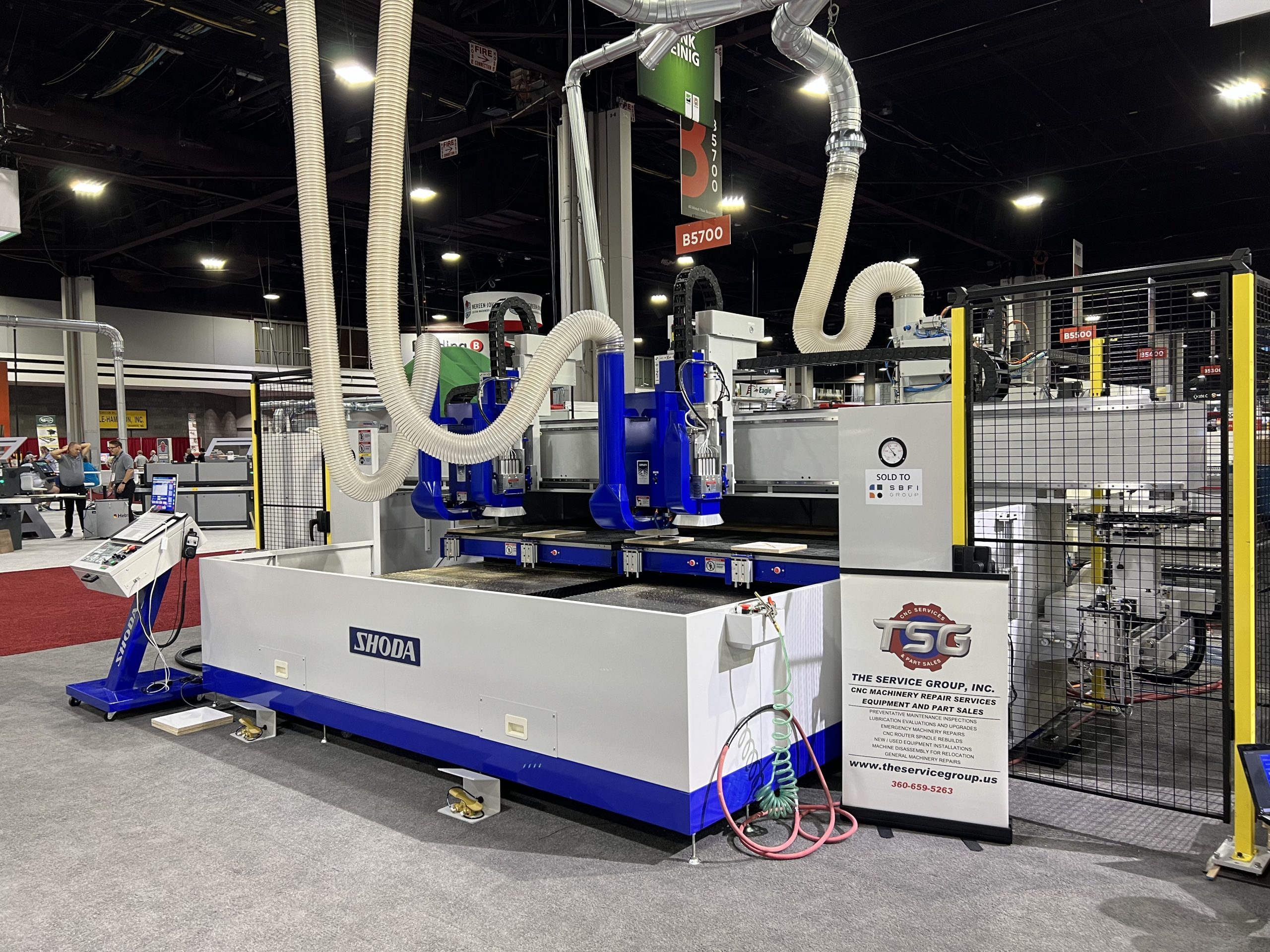
A Pioneer in Japanese CNC Router Technology
SHODA has been in business since 1926 and was the first company in Japan to develop an NC router. With a long history of precision machining, the company’s CNC routers are used to process a variety of materials—such as plastics, resins, and lightweight metals—with proven accuracy and reliability.
In 2014, SHODA developed a new type of NC router that doesn’t produce cutting dust. In many manufacturing environments, dust from machining can pose serious health risks if inhaled over long periods. SHODA’s solution to this issue has gained attention worldwide and is now used across the U.S., Europe, and Asia.