
CNC Router Guide » Applications of Japanese CNC Routers » Ultra-High-Molecular-Weight Polyethylene (UHMW / UHMW-PE) for CNC Router Processing
Ultra-High-Molecular-Weight Polyethylene (UHMW / UHMW-PE) for CNC Router Processing
What Is Ultra-High-Molecular-Weight Polyethylene?
Ultra-high-molecular-weight polyethylene—often abbreviated as UHMW, UHMW-PE, or UHMWPE—is a type of polyethylene made up of extremely long molecular chains. These chains give the material its toughness, impact resistance, abrasion resistance, and low-friction surface, making it well suited for industrial plastic components.
UHMW-PE is commonly used in parts that need to slide, guide, protect, or withstand wear. It is not typically chosen for high rigidity. Instead, manufacturers use it where durability, smooth movement, and resistance to repeated contact matter more than stiffness.
For companies machining plastic parts with a CNC router, UHMW-PE is a useful material to understand. It can be cut from sheet or plate stock into guides, liners, wear strips, slide plates, and other custom components. During routing, the main challenge is controlling material movement, heat buildup, and chip evacuation.
Main Properties of UHMW-PE
High abrasion resistance
UHMW-PE is widely recognized for its excellent wear resistance. This makes it useful for parts that come into contact with moving materials, conveyor systems, chains, sliding surfaces, or other components that rub against each other repeatedly.
Low coefficient of friction
UHMW-PE has a naturally slippery surface. In many applications, this allows parts to move smoothly with less lubrication than a typical metal-to-metal contact point would require.
High impact strength
UHMW-PE is tough and highly impact-resistant. It can absorb repeated contact and shock better than many rigid plastics, which is one reason it is often used for protective parts and wear components.
Low moisture absorption and chemical resistance
UHMW-PE absorbs very little moisture and offers good resistance to many chemicals. These properties make it valuable for parts used in wet environments, washdown areas, packaging equipment, material handling equipment, and other industrial settings.
Common Applications of UHMW-PE
UHMW-PE is used for parts that need to reduce friction, resist wear, or protect equipment surfaces. Common examples include wear strips, guide rails, chain guides, chute liners, conveyor components, slide plates, rollers, bushings, and custom machine parts.
In material handling and production equipment, UHMW-PE helps products, packages, and machine components move more smoothly. Its low-friction surface is useful in applications where repeated sliding contact can otherwise lead to noise, wear, or maintenance issues.
UHMW-PE is also used in demanding industrial and technical applications. Depending on the grade, it may be used for marine components, food processing equipment, packaging machinery, orthopedic devices, and high-performance fibers. However, requirements for food contact, medical use, or regulatory compliance depend on the specific material grade and supporting documentation, not on the material name alone.
Can UHMW-PE Be Machined with a CNC Router?
Yes. UHMW-PE can be machined with a CNC router, especially when supplied as sheet or plate stock. CNC routing is suitable for cutting profiles, drilling holes, machining slots, creating pockets, and producing custom components from flat stock.
UHMW-PE behaves differently from rigid plastics such as acrylic or phenolic board. It is tough, slippery, and relatively flexible. These properties are useful in the finished part, but they also mean the material must be held securely during machining.
For clean results, the cutting process should evacuate chips efficiently instead of rubbing against the material. Sharp tools, proper feed rates, and careful control of heat buildup help reduce burrs, melting, and poor edge quality.
CNC Router Considerations for UHMW-PE
Secure workholding is essential
UHMW-PE has a low-friction surface, so it can shift during machining if the workholding setup is not stable. Depending on the part size, thickness, and cutting pattern, vacuum tables, mechanical clamps, fixtures, tabs, or a combination of methods may be needed.
Use sharp tools and manage chip evacuation
A sharp cutting edge helps shear the material cleanly. Poor chip evacuation can lead to recutting, heat buildup, and rough edges. Tool selection and cutting conditions should be set so chips exit the cut path efficiently.
Avoid excessive heat buildup
UHMW-PE is a thermoplastic. If the cutter rubs instead of cutting, heat can affect the edge finish and may cause the material to smear. Controlling spindle speed, feed rate, depth of cut, and chip load helps keep the process stable.
Plan for flexibility and dimensional behavior
UHMW-PE is valued for toughness and sliding performance rather than stiffness. Thin parts, narrow strips, and long components may flex during or after machining. Part design, fixture design, and inspection methods should take this behavior into account.
Advantages of CNC Routing UHMW-PE
CNC routing is well suited for custom UHMW-PE parts made from sheet or plate stock. It allows manufacturers to cut profiles, openings, slots, and repeatable part shapes without dedicated molding tools.
This makes it useful for replacement parts, small- to medium-volume production, equipment modifications, and application-specific wear components. When a machine requires a custom-shaped guide, liner, spacer, or sliding surface, CNC routing can turn flat UHMW-PE stock into a functional part.
CNC routing also makes it easier to accommodate design changes. If a prototype needs a different hole pattern, edge profile, or clearance, the toolpath can be revised more easily than a mold or hard tooling setup. For manufacturers working with multiple plastic materials, this flexibility can shorten the path from design review to usable parts.
When to Choose UHMW-PE for CNC-Routed Parts
Choose UHMW-PE when the part must resist sliding wear, reduce friction, absorb impact, or perform in wet or chemically exposed environments. It is especially useful for parts that protect more expensive machine components from direct contact.
UHMW-PE is a good candidate for guide rails, wear strips, liners, pads, bumpers, chain guides, and custom sliding components. It can also be useful when metal would be too heavy, too noisy, or too damaging to the mating surface.
However, UHMW-PE is not ideal for every plastic part. It may not be the first choice for applications that require high rigidity, high-temperature performance, easy bonding, painting, or very tight dimensional stability. If those factors are critical, another engineering plastic may be a better fit.
For many industrial applications, the question is not simply whether UHMW-PE can be machined. The more important question is whether its low-friction, wear-resistant behavior matches the job the part must perform.
CNC Routers for Plastic Applications
Plastic machining involves more than cutting material to shape. Each plastic behaves differently under the tool, including how it forms chips, how it reacts to heat, how it moves during cutting, and how well it holds tolerances after machining.
UHMW-PE is a good example. Its low-friction, wear-resistant properties are valuable in the finished part, but those same properties require careful attention to workholding, tool sharpness, and cutting conditions during CNC routing.
For manufacturers processing engineering plastics, a CNC router should support stable cutting, accurate positioning, reliable chip control, and flexible production of custom shapes. These capabilities matter whether the application involves UHMW-PE, PVC, acrylic, polycarbonate, nylon, or other plastic materials.
If your company is evaluating CNC routers for plastic processing, consider more than machine size and speed. Look at how the router will handle the specific materials, part shapes, tolerances, and production volumes required in your operation.
This media is sponsored by The SHODA Company
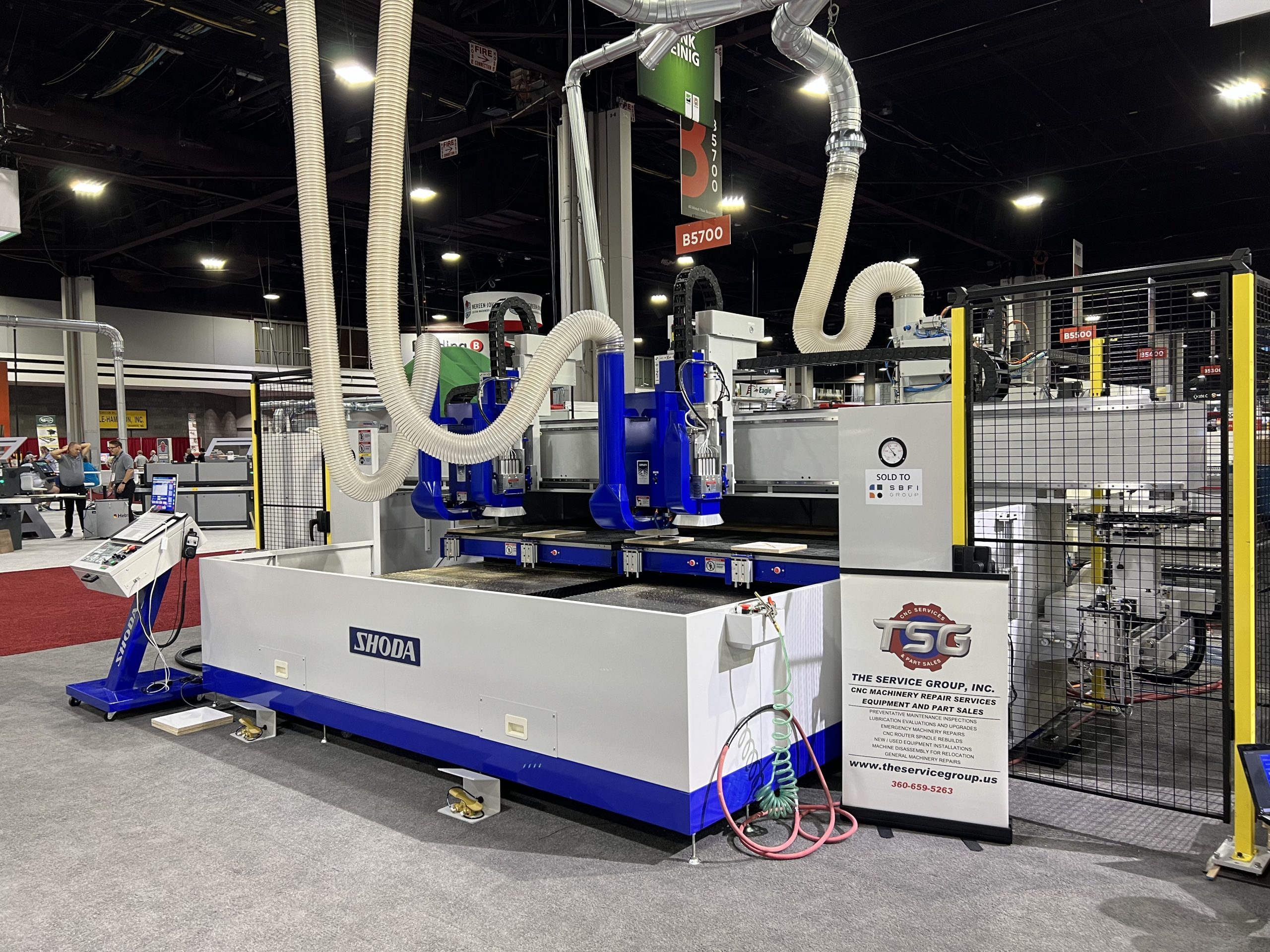
A Pioneer in Japanese CNC Router Technology
SHODA has been in business since 1926 and was the first company in Japan to develop an NC router. With a long history of precision machining, the company’s CNC routers are used to process a variety of materials—such as plastics, resins, and lightweight metals—with proven accuracy and reliability.
In 2014, SHODA developed a new type of NC router that doesn’t produce cutting dust. In many manufacturing environments, dust from machining can pose serious health risks if inhaled over long periods. SHODA’s solution to this issue has gained attention worldwide and is now used across the U.S., Europe, and Asia.