
CNC Router for PETG
PETG, or glycol-modified polyethylene terephthalate, can be machined with a CNC router. However, its properties and machining behavior can vary by formulation.
Key Takeaways
- PETG stands for glycol-modified polyethylene terephthalate, and its machining behavior can vary by formulation.
- Heat buildup, chip evacuation, vibration, and workholding can affect machining quality.
- A suitable CNC router should offer precise spindle speed and feed control, stable movement, and effective chip removal.
- Test cuts using the actual material help verify machine suitability and machining conditions.
Challenges in Machining PETG
PETG is included among the PET grades that can be processed with a CNC router. However, PET grades differ in stiffness, toughness, thermal response, and chip formation. Machining conditions that work for one grade may not produce the same results with another. The material grade and machining conditions should therefore be considered together.
Frictional heat can cause fused or cloudy edges
Friction between the cutting tool and PETG generates heat. Excessive heat can soften the material, causing fused edges, whitening, or reduced transparency along the cut surface.
Poor chip evacuation can cause tool buildup and surface damage
When chips remain near the cutting tool, they can accumulate or be cut again. This may increase heat and damage machined surfaces or protective film.
Incorrect feed conditions can cause chipping or cracking
Feed conditions that do not match the PETG grade, sheet thickness, and cutting tool can produce excessive cutting forces, potentially causing chips or cracks along the cut edge.
Rough or notched edges can become crack initiation points
Dull tools or unsuitable cutting geometry can leave rough or notched edges. These imperfections may become starting points for cracks during subsequent processing or use.
Thin sheets can lift, vibrate, or move during routing
Thin PETG sheets may lift, vibrate, or shift under cutting forces if they are not adequately supported. Such movement can affect dimensional accuracy and edge quality.
Clamping pressure can deform the workpiece
Excessive clamping pressure can deform flexible PETG sheets before machining. When the clamps are released, the material may spring back, resulting in dimensional differences in the finished part.
Chips and fixtures can scratch transparent surfaces
Transparent PETG requires careful handling to maintain its appearance. Chips, debris on the machine table, and contact with fixtures can scratch the surface during machining and handling.
Thermal expansion can affect dimensional accuracy
PETG expands with temperature changes. Differences between machining and inspection temperatures can affect measured dimensions, so temperature conditions should be considered when checking the accuracy of finished parts.
Essential CNC Router Features for Machining PETG
A CNC router for PETG should provide precise cutting control, stable machine movement, effective chip removal, and workholding that supports the material without unnecessary deformation.
Precise Spindle Speed and Feed Rate Control
The router should allow fine adjustment of spindle speed and feed rate according to the material grade, tool diameter, flute count, and required machining quality. Appropriate control helps prevent excessive rubbing and overheating.
A Rigid Frame and Low-Vibration Motion System
A rigid frame and stable motion system help reduce vibration under changing cutting loads. This supports consistent dimensions, edge quality, and surface finish across production runs.
Accurate CNC Control for Repeatable Tool Movement
Accurate CNC control coordinates feed rate, acceleration, deceleration, and tool movement. Stable motion helps maintain cutting conditions along straight cuts, corners, and curves.
Effective Air Blow and Chip Evacuation
Air blow and chip extraction help clear chips from the cutting zone before they are cut again. Removing chips also helps carry heat away from the cutting area.
Workholding That Supports the Material Without Distortion
Vacuum tables, mechanical clamps, and dedicated fixtures provide different ways to secure sheets and parts. The holding force should prevent movement without bending or stressing the material.
Compatibility With Sharp Plastic-Cutting Tools
The spindle and toolholder should accept sharp tools designed for plastics. Suitable flute geometry and tool diameter help produce clean chips while limiting cutting pressure and heat.
Programmable Ramping and Multi-Pass Cutting
Programmable ramping, controlled cornering, and multi-pass strategies can reduce abrupt tool loading. These functions can also help manage heat and chip evacuation when machining thicker PET materials.
Automatic Tool-Changing Capacity
An automatic tool changer can support parts that require multiple operations, such as drilling, profiling, pocketing, and finishing. It can reduce manual setup work and help maintain consistent machining conditions.
Process Controls for Consistent PETG Part Quality
Confirm the PETG grade, thickness, and surface requirements
Before machining, confirm the PETG grade, sheet thickness, required transparency, edge quality, and whether protective film is present. These factors help determine suitable tools and cutting conditions.
Keep the protective film in place when appropriate
Protective film can help prevent scratches during machining and handling. Follow the material manufacturer's recommendations to determine whether the film should remain in place during cutting.
Keep tables, fixtures, and work surfaces clean
Remove chips and debris from machine tables, fixtures, and work surfaces before machining. Keeping these areas clean helps prevent foreign particles from scratching transparent PETG surfaces during cutting and handling.
Select a sharp tool with sufficient chip clearance
Choose a sharp cutting tool with suitable geometry and diameter for the material and operation. Adequate flute space helps chips escape from the cutting zone and reduces chip buildup.
Balance spindle speed, feed rate, and chip load
Adjust spindle speed and feed rate together to balance cutting forces and heat generation. Suitable settings depend on the PETG grade, sheet thickness, tool geometry, and machining operation.
Control depth of cut and the number of passes
Set the depth of cut and number of passes according to sheet thickness, tool diameter, part geometry, and finish requirements. Appropriate settings help manage cutting forces and heat.
Remove chips and heat from the cutting zone
Use suitable air blast or extraction to remove chips from the cutting zone. Effective chip removal helps limit chip buildup, repeated cutting, and heat accumulation around the tool.
Avoid coolants that may cause stress cracking
If coolant is used, check its chemical compatibility with PETG before machining. Incompatible fluids may contribute to stress cracking. Water or compressed air may be options for managing heat, depending on the application.
Verify settings with test cuts and documented inspection
Run test cuts using the actual PETG material and inspect dimensions, edge quality, whitening, chipping, and scratches. Record the settings and inspection results to support consistent production.
Signs That Your Current CNC Router May Be Limiting Production
Machine age alone does not determine whether replacement is necessary. Evaluate recurring quality problems, productivity losses, and inconsistent results, while distinguishing issues that tooling or parameter changes can resolve from limitations caused by the equipment itself.
Fused, rough, or cloudy edges occur repeatedly
Repeated fused, rough, or cloudy edges may indicate excessive heat, unsuitable tooling, or ineffective chip removal. Review cutting conditions before deciding whether the machine is limiting quality.
Chipping and cracking continue despite tooling changes
If chipping and cracking persist after suitable tools and cutting conditions have been tested, review machine stability and motion control to determine whether equipment limitations contribute to the defects.
Transparent surfaces are frequently scratched during machining
Frequent scratches on transparent PETG surfaces may result from chip buildup, contaminated work surfaces, or contact with fixtures. If cleaning and handling improvements do not resolve the issue, review the machining setup.
Dimensional results drift during longer production runs
Dimensional changes during extended production may reflect temperature variation, tool wear, or inconsistent machine performance. Check these factors and compare inspection results to identify the likely cause.
The machine cannot evacuate chips consistently
Inconsistent chip removal can increase heat buildup and cause chips to be recut. If adjustments to extraction, air blast, tooling, and cutting conditions are insufficient, the machine's chip-removal capability may be limiting production.
Manual chip clearing and secondary finishing reduce throughput
Frequent manual chip clearing, deburring, or additional finishing increases cycle time and labor. Review whether improved tooling and process settings can reduce these tasks or whether equipment capabilities need upgrading.
New customer requirements exceed the machine’s capabilities
New requirements for dimensional accuracy, surface quality, part size, or production volume may exceed the current machine's capabilities. Compare actual results with customer specifications before deciding whether replacement is necessary.
How to Evaluate a Replacement CNC Router for PETG Machining
Evaluate a replacement CNC router against actual production requirements rather than relying on machine specifications alone.
Define the Required Tolerances and Surface Finish
Translate customer drawings and specifications into measurable requirements, including dimensional tolerances, flatness, edge condition, transparency, burr limits, and surface finish.
Confirm the Material Grade, Thickness, and Dimensions
Record the exact material grade, stock form, thickness, and workpiece dimensions. These factors affect tool selection, workholding, and machine capacity.
Match the Table Size and Axis Travel to the Workpiece
Check the table dimensions and X, Y, and Z travel against current parts, fixture requirements, material size, and planned products. The working area should accommodate the intended workpieces and setups.
Evaluate Spindle Range, Feed Control, and Machine Rigidity
Confirm that spindle speed, feed control, acceleration, and machine rigidity can maintain stable cutting conditions with the intended material grades and tools.
Check air blast and chip extraction performance
Evaluate how effectively the machine removes chips from the cutting zone. Consider air blast and extraction together with the intended tools and cutting conditions.
Compare vacuum and mechanical workholding options
Compare vacuum tables and mechanical clamps based on the workpiece shape, sheet thickness, and required holding stability during machining.
Confirm that fixtures can protect finished surfaces
Check that fixtures support the PETG sheet securely without scratching visible surfaces or applying excessive pressure that could deform the material.
Review maintenance, parts availability, and after-sales support
Review maintenance requirements, spare-parts availability, and after-sales support to understand the practical considerations of operating the machine over time.
Request a test cut using the actual PETG sheet
Ask the supplier to perform a test cut using the actual PETG sheet and representative machining conditions before making a purchase decision.
Inspect dimensions, edges, clarity, and surface scratches
Inspect the test piece for dimensional accuracy, edge quality, transparency, and scratches to determine whether the machine meets the intended application requirements.
How SHODA CNC Routers Support Plastic Machining Requirements
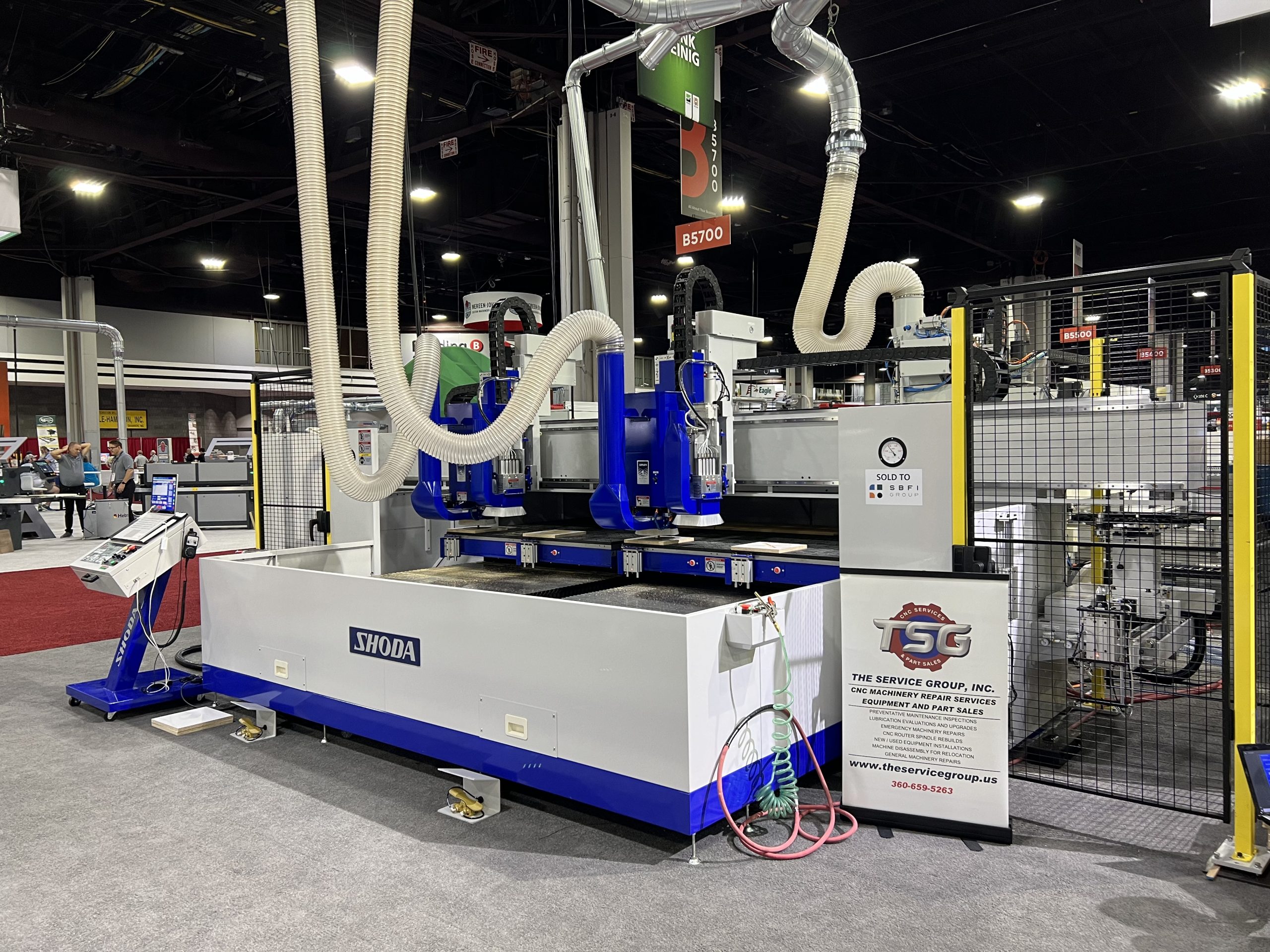
SHODA develops CNC routers for plastic machining. Depending on the model and configuration, available features include precise spindle control, rigid machine construction, enhanced air blast, and workholding options for different sheet sizes and part geometries.
Machine capabilities for stable plastic machining
SHODA CNC routers offer features for plastic machining, including spindle control and chip-removal solutions. The NCN8210 features an AC spindle and Center-Through Air Blow II, which helps prevent chip buildup during machining.
Configurations for different sheets and production volumes
Machine configurations can be evaluated according to sheet dimensions, workholding requirements, machining operations, and production volume. Confirm table size, head configuration, and tool-changing options with SHODA to identify a suitable setup.
Application-specific consultation and machining tests
Discuss PETG sheet thickness, part geometry, surface quality requirements, and production volume with SHODA when evaluating a suitable machine. Testing the actual material can help determine whether the proposed configuration meets application needs.
For more information, visit the SHODA official website.
This media is sponsored by The SHODA Company
A Pioneer in Japanese CNC Router Technology
SHODA has been in business since 1926 and was the first company in Japan to develop an NC router. With a long history of precision machining, the company’s CNC routers are used to process a variety of materials—such as plastics, resins, and lightweight metals—with proven accuracy and reliability.
In 2014, SHODA developed a new type of NC router that doesn’t produce cutting dust. In many manufacturing environments, dust from machining can pose serious health risks if inhaled over long periods. SHODA’s solution to this issue has gained attention worldwide and is now used across the U.S., Europe, and Asia.